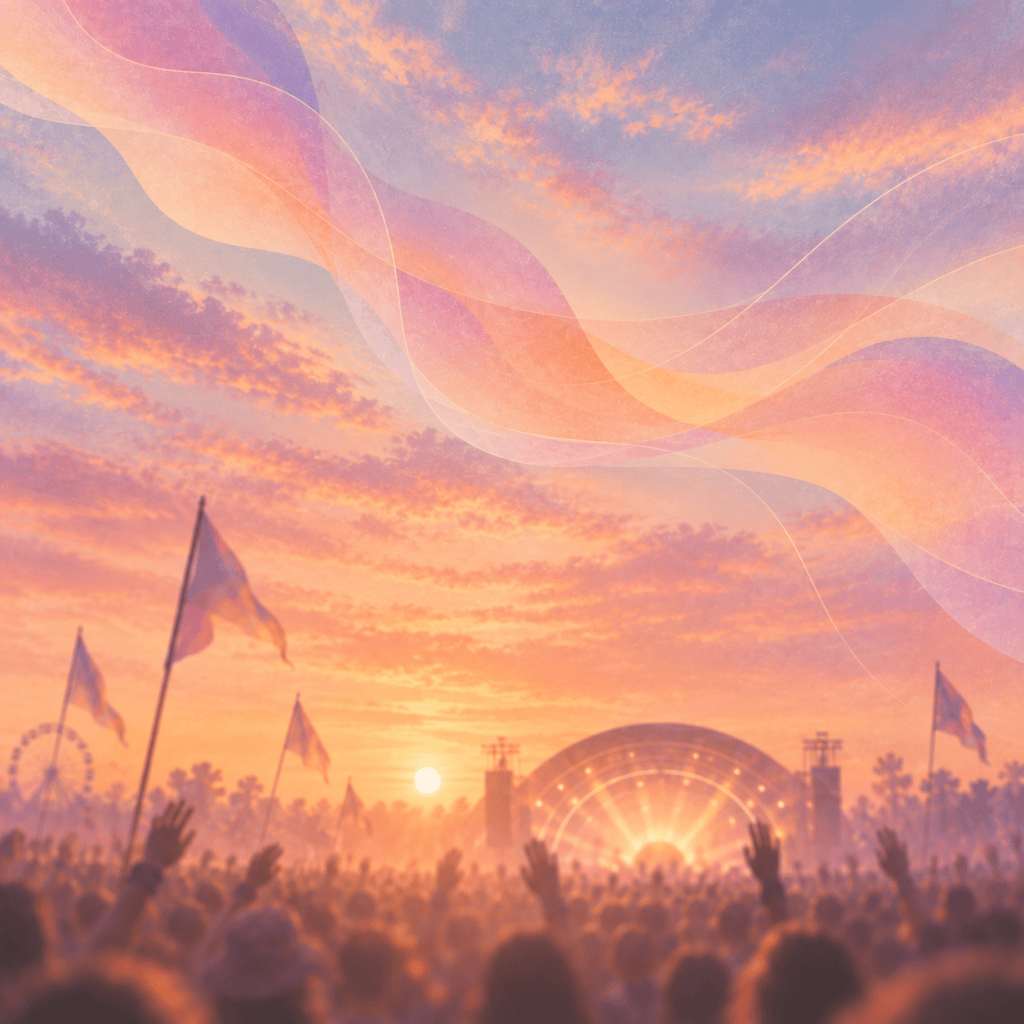
My first festival completely changed my life.
I went into Bonnaroo Music & Arts Festival excited to see some of my favorite artists with a couple of my friends. What I hadn’t realized is how much more this space would hold.
The energy was palpable before we even arrived. We spent the drive down listening to the artists we were excited to see, imagining what the week ahead might hold. As we got closer to the Farm, we hit standstill traffic – the kind that would normally make anyone irritable and anxious. Except this wasn’t normal traffic. People were out of their cars blasting music, playing catch in the road, sharing drinks and laughs with strangers. Even in the nearly ten-hour line of cars waiting to get in, you could feel the energy building around us.
This energy carried throughout the entire weekend as we danced from stage to stage beneath the lights and lasers, sang aloud to our favorite songs in a crowd of thousands, laughed until the sun came up, connected with strangers, and seemed to make friends around every corner.
As the weekend unfolded, I felt myself opening. I had never been particularly comfortable with self-expression or felt completely accepted simply for being myself. At Bonnaroo, I was surrounded by people expressing themselves freely and being met with that same openness in return. I felt my soul expanding through the community, the connection, the radical acceptance, and the genuine love I experienced there. For the first time, I began to understand what it felt like to be unapologetically myself – and to love that version of myself unconditionally rather than hide it.
Standing in the crowd feeling so deeply accepted, welcomed, and connected, I remember thinking, “I wish every day could be like this.”
When we packed our cars on the last day, hot and exhausted, I could feel that something in me had shifted. Being immersed in that community for a week had opened my heart and changed the way I thought about the world around me. I didn’t want to leave that version of myself behind when I left the Farm. I wanted to find a way to carry it home.
Bonnaroo is rooted in a core set of values that shape the culture of the festival. While they are laid out in what is known as the Bonnaroovian Code, the values behind them are reflected throughout festival culture more broadly, including play as a team, respect the farm, don’t be that person, stay true Roo, and perhaps the one most synonymous with Bonnaroo – radiate positivity.
Radiating positivity encourages attendees to spread positive energy through smiles, kindness, openness, and “being awesome to one another.” The festival is built on this pillar of positivity, and you can truly feel its radiance throughout the Farm and in interactions with others. It sounds simple, but when tens of thousands of people enter a space with that shared expectation, it begins to shape the culture around them. I watched people continue to radiate that positivity through the heat, the traffic, the exhaustion, and all the little difficulties that come with spending days living in a field. Experiencing that kind of openness and positivity made me want to bring more of it into my everyday life.
I carried those principles with me as I returned to my normal routines and began to notice the ways I was changing. I came home from that first Bonnaroo with a more positive outlook, a deeper desire for connection, a greater impulse to help the people around me, and a more open heart than I’d had in a long time. I felt softer. More inspired. More creative. More willing to express myself freely and extend that same acceptance to others.
I had gone to Bonnaroo expecting a week of music. I came home feeling transformed.
So why do festivals feel so transformative?
Humans have long sought experiences that move us beyond our ordinary ways of being, though the spaces in which we find them continue to evolve. One of the most compelling contemporary examples is the music festival – a gathering that, while framed as entertainment, often mirrors the structure and impact of ancient ritual and spiritual practice. Beneath the lights and sounds, festivals can become powerful spaces for connection, transformation, and expanded states of consciousness.
Expanded states of consciousness, those that shift us from our ordinary patterns of awareness, can be accessed in a variety of ways. Traditional practices have often used rhythm, chanting, dance, music, movement, breathwork, and other forms of sensory immersion to shift ordinary awareness. These techniques can shift perception, disrupt habitual patterns, interrupt the ordinary mode of being, and allow for more expansive experiences of consciousness to emerge.
Music festivals, by design, engage many of these same sensory pathways. With music, dancing, movement, and visual stimulation at their core, they naturally lend themselves to expanded states, creating conditions for transformation and transcendence. In this way, festivals can serve as a sort of catalyst, inviting participants to move beyond the mundane into a more expansive state of being.
The immersive soundscapes and rhythmic patterns of live music, in combination with collective movement, can contribute to trance-like states in which the boundaries between self and others feel less distinct. Music has a unique capacity to stir memory, evoke emotion, and carry us into liminal spaces. When paired with dance and communal energy, music becomes an embodied, collective experience capable of shifting the way we experience ourselves and those around us.
At their heart, music festivals mirror many of the elements of ritual. Anthropologically, rituals are often characterized by structure, symbolism, and shared intention. They create a container in which transformation can occur, both individually and collectively.
Music festivals follow a similar structure, with symbolic elements that emerge through themes, costumes, visual art, collective anticipation, and even the sacredness of the main stage at sunset. For a few days, they provide a space where ordinary routines and social roles are temporarily suspended, allowing participants to engage in more authentic or expressive versions of themselves.
This temporary suspension of ordinary life echoes what anthropologist Victor Turner described as liminality, or a threshold state of being between worlds, where ordinary structures and identities become less fixed. Within this liminal space, people may become more open to new insights and ways of understanding themselves, relating to others, and imagining who they might become. Within the context of a festival, this liminal space can create room for emotional release, experimentation with identity, and experiences that challenge the boundaries of the ordinary self. When participants eventually re-enter everyday life, they may return with a renewed sense of self or purpose, or a different understanding of the world around them.
One of the most profound forces of the festival experience is the energy of the crowd itself – the sense of unity that arises through shared emotional and physical expression. Sociologist Émile Durkheim referred to this phenomenon as collective effervescence, or the heightened sense of shared emotion and collective energy that can emerge when people gather and participate in communal experience.
Here, at the festival, thousands of people enter this temporary world with a shared intention: to experience the music, dance, celebrate, connect, and step outside the routines of everyday life. We sing together, move together, laugh together, and experience our favorite music alongside thousands of other people doing the same. In these moments, we can become so immersed in the present and in one another that we experience the collective energy directly, transcending the boundaries of our individual selves as we connect to something bigger and more expansive.
The dancefloor becomes more than a space for movement; it becomes sacred ground. Strangers become mirrors. Voices sing together. The crowd breathes as one. These shared emotional peaks can lead to a dissolution of personal boundaries, giving rise to a profound sense of connection with the collective. This connection feels both intimate and infinite – a connection to the group, but also to something cosmic.
Beyond these profound moments of collective effervescence, however, live the smaller moments that can leave just as lasting an impact. A stranger gives you directions to a stage. Someone gives you a sip of their water. You unexpectedly run into a friend. You wrap your arms around the people you love and sing your heart out to your favorite song. These moments remind us of our humanity – of the importance of being kind, compassionate, generous, and loving toward one another, both within the festival and beyond it.
It is through both the profound and the seemingly ordinary that transformation unfolds. These experiences can shift something within us, planting seeds that continue to grow long after the lights go out and the music fades. As we carry them back into everyday life and begin to integrate what they have shown us, they can shape our perspectives, values, and the ways we relate to ourselves and others, fostering a heightened sense of empathy, a greater appreciation for community, or a deeper understanding of our own identity.
The festival ends, but the experience continues to unfold within us.
We return home more empathetic, more open, and in some ways, more ourselves. After my first Bonnaroo, I continued traveling around the country to festivals, each one opening me a little further and shaping the person I was becoming. No two festivals, or even two moments within a festival, have transformed me in quite the same way. Some of these experiences have been defined by profound moments of collective effervescence, while others have been marked by smaller moments of humanity and kindness. Together, they have continued to shape the way I relate to myself, to others, and the world long after the experience ends.
In moments of collective participation, I have felt the boundaries of my Self dissolve, loosening the everyday separation between myself and those around me. Within that dissolution, I have experienced profound moments of spiritual expansion – moments when connection seems to extend beyond the people standing beside me and into something much greater. There is something cosmic about these experiences. For a moment, I experience the interconnectedness I believe exists beneath our ordinary sense of separation, not as an abstract spiritual idea, but as something I can actually feel. These experiences have shaped the way I understand consciousness and reality, expanding my sense of who I am and what I am connected to.
Yet, it is often the smaller moments that stay with me just as deeply – a stranger giving me a trinket because they like my outfit, a friend giving me a sip of water when I am dehydrated and exhausted, holding my friends close during the last song of the night. Through these interactions, strangers become friends, and friends become family. These moments remind me of our humanity and how little it can take to make another person feel seen, cared for, or less alone.
These moments, whether infinite or intimate, both point towards connection. One shows me what it feels like when boundaries between self and others dissolve through spiritual expansion; the other shows me what connection looks like when it takes human form: kindness, generosity, presence, and care. One reminds me that I am part of something far greater than myself; the other reminds me of my responsibility to the people with whom I share it.
I have learned to carry both into the way that I live. Festivals have made me more open and accepting of myself and others, more authentic in the way I express myself, more aware of my spiritual nature, and more conscious of how deeply we need community and connection. The person I become within these spaces no longer feels separate from the person I am in everyday life. Rather, festivals have given me a space to discover and practice ways of being that I want to embody beyond them.
At my first Bonnaroo, I remember thinking, “I wish every day could feel like this.” Now, I understand that every day doesn’t need to feel like a festival for me to live according to what festivals have taught me. I can choose openness. I can express myself freely and offer that same acceptance to others. I can look for opportunities to make someone feel seen or cared for. I can seek connection in the ordinary moments of my life and remember the deeper connection I have experienced in the extraordinary ones.
Every festival has shaped me differently, but the transformation has never ended when the music does. I carry who I become there home with me.
A Thread to Follow
Have you ever left a music festival feeling different from the person who arrived? What changed within you, and what stayed with you after you returned home?
If festivals aren’t your space, have you ever had an experience or entered a space that transformed you in a similar way?
If an experience came to mind while reading, I’d love to hear about it. What did you carry home with you? Feel free to share your own thread below!
Until next time ✨

