Tag: identity

  • Weaving the Self into the Whole: Radical Generosity and the Unraveling of Ego

    Weaving the Self into the Whole: Radical Generosity and the Unraveling of Ego

    When discussing music festivals and consciousness, it is easy to see how these ceremonies of sound can induce mystical states that lead to transformation and positive change. Much of this is even rooted in the values that festivals are built upon. One of the most powerful tenets is radical generosity, or the profound desire to give and to share. This principle is not grounded in obligation or performance, but in an awareness that there is no longer a “me” or “you.” There is only us.

    This is the essence of radical generosity, and it often arises not in the waking mind, but in expanded states of consciousness where ego dissolves and the transpersonal begins.

    Radical generosity isn’t simply giving money, things, or time. It is the unguarded giving of the self. It defies the logic of ego, the part of us that asks, “what’s in it for me?” Instead, it is soul-level recognition that to give is to affirm our shared being.

    This kind of generosity is revered across several spiritual traditions. For example, in Buddhism, dāna (generosity) is the first perfection, the foundational practice of awakening. In many indigenous teachings, generosity is shared reciprocity, offering back to the web of life in recognition of interdependence. And in psychedelic experiences, generosity often arises spontaneously when the walls between self and other begin to dissolve, revealing unity beneath our perceived separateness.

    At music festivals, this spirit is more than philosophy; it is felt in each moment. It lives in the shared water during a hot set, the stranger helping you up off the ground, the hugs at sunrise from someone who understands. It lives in the spontaneous gifts, trinkets, glitter, stickers, and affirmations passed from person to person. These moments are not transactional, but rather sacred reminders that we belong to each other. Here, generosity becomes ceremony, and the dancefloor becomes a temple of connection.

    In ordinary, waking consciousness, the ego stitches our identity together. It is the part of us that says “I am separate.” It defines roles, defends boundaries, and creates distinction between mind and yours, between me and you. It guards, compares, and defends. It is not bad, but necessary in ordinary states of being.

    However, in altered states, especially those influenced by psychedelics, the ego often dissolves, allowing for a glimpse of something greater and more connected. In these moments, the boundaries between self and others blur, and the thread of self begins to weave back into the tapestry of something greater. The self is not diminished but diffused into belonging. Empathy is not conceptual but embodied. Love and connection are no longer felt as emotions but become what we are. And from this space of connection, love, and empathy; generosity flows. Not because you should give, but because you are not other than what you are giving to.

    When the ego dissolves in those moments of expanded consciousness, we remember that we are not separate. We are inherently interconnected to all – to others, to nature, to the universe. As the illusion of separation and aloneness falls away, what remains is a shared journey, a collective unfolding. We realize that we are not the contents of our mind, our possessions, roles, or identities. We are all expressions of the same field of awareness, just different waves in the ocean. Through this remembrance, generosity becomes natural, essential even. Every act of giving is an act of self-recognition, and love isn’t just something we do; it’s what we are made of.

    While these experiences of expanded consciousness often reveal this innate unity, the real transformation happens in integration, or how we live afterward. Radical generosity becomes a practice of re-membering: offering your attention, your presence, your gifts, your kindness, your empathy. Each act becomes a thread weaving you back into the whole.

    In this way, transformation occurs when we remember the true interconnected nature of our selves and our realities. When we remember that we are all connected, all one, it changes the way we interact with others and the world around us. But this goes beyond personal transformation. When practiced regularly, these small acts of generosity begin to shift cultural norms towards mutual care. Kindness multiplies, compassion spreads. This is how individual awakening ripples into collective transformation.

    In my own journey, I have felt moments in which my ego has dissolved, and I’ve experienced unity with everyone, and even everything, around me. These moments bring with them a sense of clarity about the interconnected nature of reality, lending to the realization that we are all one. I’ve come to know that we are all the universe experience itself and expressing itself through our individual perspectives. And that’s exactly it – we are interconnected pieces of the same whole. In this way, our actions are not just what we do unto others, but also ourselves.

    In my experience, the integration of this insight can facilitate profound shifts in behavior, such as through radical generosity, acceptance, kindness, and love. I have felt myself grow softer, kinder, more empathetic, and more generous with those around me as I realize that they are also me. But the truth is, when we return to our everyday states of awareness and ego rises back to the forefront, it becomes difficult to maintain these morals and principles, despite the innate knowing that we are all one. It is easy to fall back into ingrained patterns, allowing ego to guard and defend. But the more we practice, the more integrated it becomes. That is why, for me personally, returning to music festivals becomes more than just entertainment or a fun time. It is a return to Self, as I remember these insights and practice these principles. I share love and kindness, smiles and energy, trinkets and toys with those around me. Not out of obligation, but because I remember.

    Radical generosity goes beyond selflessness or spiritual performance. It is a remembering that the self is much greater than we thought; that love isn’t something we do, but who we are in our souls. In these transpersonal moments of expanded consciousness, we glimpse this, and in generosity, we live it. As the mystics might say: “When I give to you, I give to myself. When I withhold it, I forget who I am.”

    So often, we wait for special moments, as in altered states, to remind us that we are all connected. But the truth is, that knowing lives within us always, waiting to be reawakened in the small, generous acts of daily life. So this week I invite you to reflect on a moment, however small, in which you felt deeply connected to another person through presence or giving. What did that moment reveal about your relationship to self and other? How might you carry that awareness forward?
  • The Dancefloor and the Divine: Festivals as Portals of Connection

    The Dancefloor and the Divine: Festivals as Portals of Connection

    In modern society, the search for transcendence often takes unconventional forms. One of the most compelling examples is the music festival – a contemporary gathering that, while framed as entertainment, often mirrors the structure and impact of ancient ritual and spiritual practice. Beneath the lights and the sound, something deeper is unfolding. Music festivals have emerged as powerful spaces for connection, transformation, and transcendence into expanded consciousness.

    Festivals as Catalysts for Altered States of Consciousness

    Altered states of consciousness, those that shift us from ordinary waking consciousness, can be accessed in a variety of ways. Traditional methods often rely on sensory immersion, including rhythm, chanting, dance, music, movement, and breathwork. These techniques shift perception, disrupt habitual patterns, interrupt the default mode of being and allow for something more expansive to emerge.  

    Music festivals, by design, engage many of these same sensory pathways. With music, dancing, movement, and visual stimulation at their core, they naturally lend themselves to nonordinary states of consciousness, creating the conditions for transcendence. In this way, festivals can serve as a sort o catalyst, inviting participants to move beyond the mundane and into an expansive, altered state of being.

    The immersive soundscapes and rhythmic patterns of live music, in combination with collective movement, can create trance-like states that loosen the boundaries of identity. Music has always been more than sound. It stirs memory, invokes feeling, and carries us into liminal spaces. When paired with dance and communal energy, it becomes something even more powerful – a pulse that dissolves separation and allows for transcendence.

    While some may choose to enhance these experiences with psychedelics or other substances, the festival environment itself, through multisensory immersion, freedom of expression, and emotional resonance, can be enough to induce altered states on its own.

    Festivals as Modern-Day Rituals

    At their heart, festivals are more than gatherings; they are rituals in disguise. Music festivals mirror many of the key elements of ritual. Anthropologically, rituals are defined by structure, symbolism, and shared intention. They create a container in which transformation can occur, both individually and collectively.

    Music festivals follow a similar structured format, with symbolic elements that show up in themes, costumes, visual art, collective anticipation, and even the sacredness of the main stage at sunset. They provide a space where normal social roles are temporarily suspended, allowing participants to engage in more authentic or expressive versions of themselves.

    This temporary suspension of ordinary life echoes what anthropologist Victor Turner described as liminality, or a threshold state where individuals are between worlds, open to new insights and identities. In the context of a festival, this liminal space can allow for symbolic ego death, emotional release, and re-entry into daily life with a renewed sense of self or purpose.

    It is in these moments, like dancing under the lights, crying during your favorite song, laughing until the sun rises, that something old falls away and something deeper returns. A ritual. A rite of passage.

    Collective Effervescence and the Shared Field

    One of the most profound forces of the festival experience is the energy of the crowd itself. It is the sense of unity that arises in shared emotional and physical expression. Sociologist Émile Durkheim referred to this phenomenon as collective effervescence, or the experience of shared emotion and synchronized energy that occurs during communal rituals.

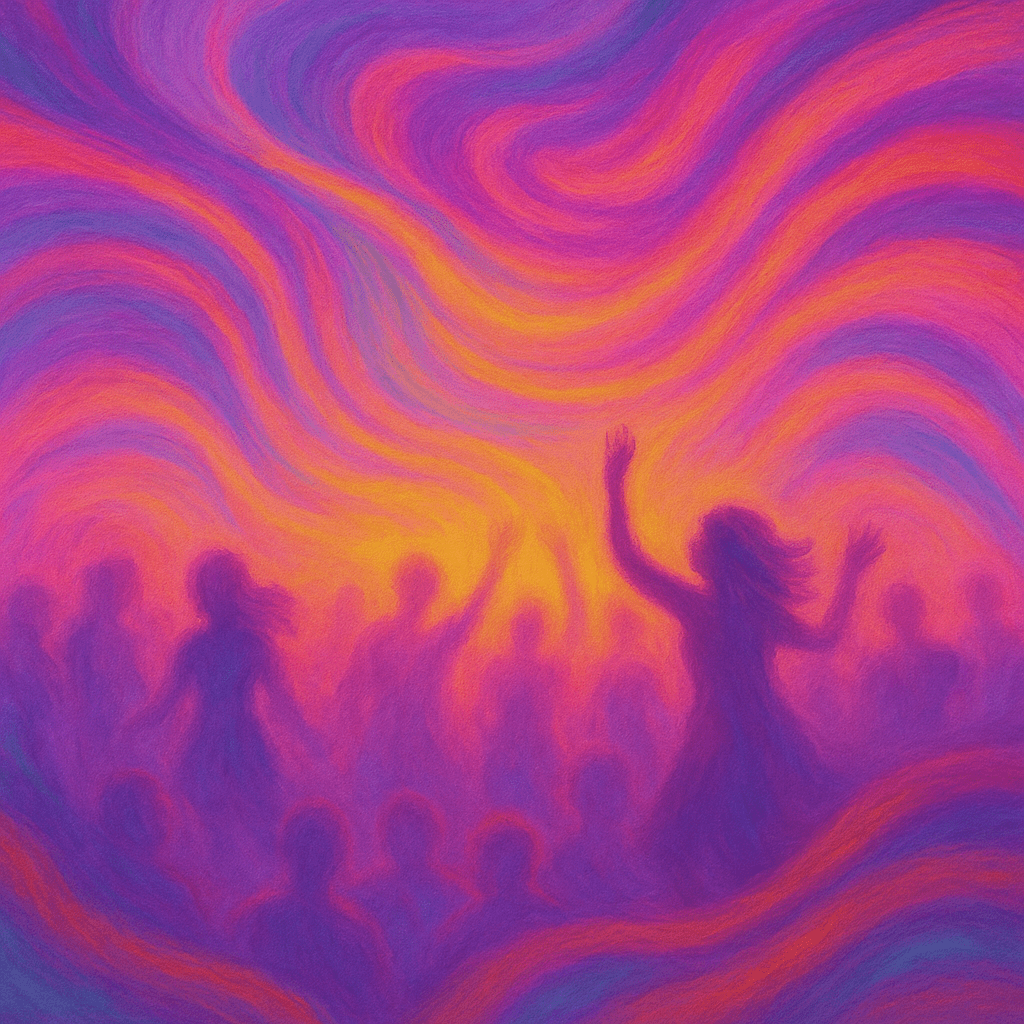
    In these moments, the dancefloor becomes more than a space or movement; it becomes sacred ground. Strangers become mirrors. Voices sing together. The crowd breathes as one. These shared emotional peaks can lead to a dissolution of personal boundaries, giving rise to a sense of connection with the collective. This connection feels both intimate and infinite – a connection to the group but also a connection to something cosmic.  

    This state of heightened connection not only fosters belonging, but may also open the door to deeper forms of awareness. These experiences might tap into what Carl Jung called the collective unconscious, or the collection of shared archetypes, emotions, instincts, and symbols common to all of humanity. Within this space, archetypes like ecstasy, rebirth, and unity come alive through the music.  

    In this sense, festivals become more than cultural gatherings and an escape from reality. Rather, they are reminders of a deeper one, offering a glimpse into the interconnected nature of consciousness itself.

    Transformation through Connection

    These moments of transcendence and expanded awareness often stay with us. They shift something internal, planting seeds that continue to grow long after the lights go out and the music fades.

    When integrated, these moments of expanded awareness and connection often inspire lasting changes in perspective, values, and behavior. Participants may leave with a heightened sense of empathy, a greater appreciation for community, or a deeper understanding of their own identity. These shifts, whether small or profound, reflect the transformative potential of collective, embodied experience. We return home more empathetic, more ourselves.

    And so, the festival becomes more than an event. It is a ritual of connection through expanded consciousness. Echoes of ancient practices reimagined in a modern cultural landscape. A remembering of who we are, how we are connected, and what we are here for.

    These moments on the dancefloor – where rhythm meets presence and the self dissolves into something greater – often leave us changed. While these moments may be fleeting, they invite us to pause, reflect, and carry their resonance forward.

     So this week I invite you to reflect: Have you ever felt yourself dissolve into a moment, whether through music, movement, or shared energy? What did that experience reveal about your connection to self, others, or something greater?

    References

    Jung, C.G. (1936). The concept of the collective unconscious. C.W. Vol. 9.1. Princeton University Press.

    Rimé, B. & Páez, D. (2023). Why we gather: A new look, empirically documented, at Émile Durkheim’s theory of collective assemblies and collective effervescence. Perspectives on Psychological Science, 18(6), 1306-1330.

  • Beyond Separation: Connection through Altered States of Consciousness

    Beyond Separation: Connection through Altered States of Consciousness

    Most of us live our daily lives with the sense that we are separate from each other, contained within our own bodies, thoughts, and experiences. This sense of individual selfhood helps us function in everyday life, but it also creates the illusion that we are fundamentally alone, disconnected from one another and from the larger whole.

    Yet, when we shift into nonordinary states, the illusion of separation starts to unravel. In such states of consciousness, as in those accessed through deep meditation, psychedelics, or other portals, many people report a profound sense of connection. These states seem to reveal what lies beneath the surface of our everyday awareness: that we are not, in fact, separate. We are deeply, inherently interconnected.

    Some experiences of nonordinary consciousness point to a phenomenon known as ‘shared mind,’ where the boundaries of separate consciousness begin to blur. These include experiences of telepathy (mind-to-mind communication without sensory involvement) and clairvoyance (accessing information without sensory input), both of which defy the logic of separation (Barušs & Mossbridge, 2017). Instead, these experiences lend to the idea of a shared mind, which allows or access to a unified field of consciousness – something larger that connects us all. While these experiences fall outside of ordinary sensory perception, they suggest that our minds might not be as isolated as we think.

    Mystical experiences, too, contribute to the idea of a shared mind. These experiences are often accessed in deeply altered states of consciousness and offer another kind of connection: not just between minds, but between everything. Many who experience these mystical states describe a sense of oneness and unity with something greater. Sometimes this unity is internal – an ego-dissolving recognition that one belongs to the universe. Other times its external – an awareness that all beings, all things, are made of the same source, the same matter, the same light.

    These mystical states echo across traditions and cultures. While the language used to describe them varies, the essence is the same: there is no “other.” There is only one.

    These states are the most expansive reaches of consciousness, where one identifies not only with other people, but with animals, nature, and even the cosmos or universe in its entirety (Grof, 2019). In this unitive experience, time, space, and separation dissolve. What’s left is a deep knowing: I am not separate from the universe; I am part of it. I am it.

    This experience of unitive oneness shifts more than just perspective. It transforms the way we live. When we no longer perceive ourselves as isolate beings, but as parts of a expansive, interconnected whole, we begin to relate to others differently. We meet the world with more love, more compassion, more care. We see that how we treat others is, in a sense, how we treat ourselves.

    In my personal experience, while I’ve often grazed the surface of inherent connection in altered states, one particular experience opened the door to something more expansive, what so many have described as unitive oneness. I was at a music festival, my happy place, surrounded by people I loved with my favorite music as the soundtrack, when something shifted. I felt myself begin to dissolve into everything around me. I felt deeply connected, not just emotionally, but energetically, as if my breath was literally breathing love into the people around me. Even more, the stage itself seemed to be holding me, like I was being cradled by the sound, the beat of the music breathing through my body.

    It was more than just a connection to others. It was a profound sense of connection to everything – the artist, the crowd, the earth beneath me, the air around me, and the music itself. That moment changed something in me, awakening a knowing deep in my soul and calling me live from that space. Love. Compassion. Kindness. Those are the most important things. Because we are not separate, we are all connected. We are all one.  

    This expanded awareness invites us to live differently. It reminds us that love and empathy aren’t just virtues; they’re natural responses when we recognize our shared essence. If we are all part of the same whole, then kindness becomes not just an act, but a way of remembering who we are.

    These states of consciousness, whether fleeting or profound, offer a glimpse of something that resonates more deeply than the illusion of separateness. They show us we are not alone, not broken, not disconnected.

    We are part of each other. We are part of something cosmic and infinite. And at the deepest level, we are one.

    These moments, whether they arrive in mystical states or in quiet stillness, leave us with a deeper understanding of what it means to be human. When we soften the boundaries between self and other, between body and beat, between me and we, we remember something ancient, something true.

    So this week I invite you to reflect: have I ever experienced a moment where I felt more connected to everything around me? What did that connection feel like, and how did it shift the way I see myself in the world?

    References

    Barušs, I. & Mossbridge, J. (2017). Transcendent mind: Rethinking the science of consciousness. American Psychological Association.

    Grof, S. (2019). The way of the psychonaut: Encyclopedia for inner journeys (Volume One).MAPS.

  • Psychedelics and the Path to Expansion: Catalysts of Consciousness

    Psychedelics and the Path to Expansion: Catalysts of Consciousness

    Throughout history, humans have turned to sacred tools to shift awareness: ritual, breath, stillness, and sound. But among these technologies of the sacred, few have been as potent, or as controversial, as psychedelics.

    In both traditional and clinical settings, psychedelic substances have been used to induce non-ordinary states of consciousness that foster healing, insight, and transformation. While practices like meditation or breathwork often rely on personal rhythm and repetition over time, psychedelics act as catalysts, compressing what might otherwise take months of therapeutic work into a matter of hours. They can open the psyche in powerful ways, unveiling unconscious material, loosening rigid patterns, and allowing new ways of being to emerge.

    The word psychedelic itself comes from Greek – psyche, meaning “mind” or “soul,” and delos, meaning “to make visible.” And that’s exactly what these substances seem to do: they make the hidden parts of ourselves visible. They bring forth what has been buried, suppressed, or forgotten in order to process, resolve, and ultimately integrate.

    From ancient shamanic rituals to contemporary clinical trials, psychedelics have long been used as tools for transformation. Indigenous traditions around the world have used plant medicines like ayahuasca, peyote, and iboga in ceremonial contexts, viewing them not as drugs, but as sacred guides to deeper truths and spiritual healing.

    In the West, psychedelic research began in earnest in the mid-20th century. Early studies with LSD, psilocybin, and mescaline revealed the power of these substances to enhance creativity, alleviate anxiety and depression, and support individuals facing terminal illness. At their best, these experiences created space for people to reconnect with their core selves, release long-held emotional pain, and develop new insight into their lives.

    The golden era of psychedelic research was brief, however, as cultural backlash and political fear led to widespread criminalization and the halt of scientific exploration. But in recent years, we’ve seen a resurgence; a psychedelic renaissance driven by promising studies on the therapeutic potential of substances like psilocybin, LSD, MDMA, and ketamine.

    Today, psychedelic-assisted psychotherapy is showing extraordinary promise. When used with intention, preparation, and integration, psychedelics appear to activate what Michael Mithoefer calls the “inner healing intelligence” – a deep, innate capacity for psychological and spiritual healing. They help us to access the grief, shame, fear, or trauma that often live just beneath the surface of our everyday awareness, shaping our lives in unseen ways.

    Through this research and my own lived experience, I’ve come to understand these states not as distortions of reality, but as expansions of it. They allow us to step outside our everyday awareness and touch something deeper, more whole. In my own journey, these states have helped me begin to see my true self. For so long, I defined myself solely as the human ‘me’ walking the earth, full of fear, grief, and shame. I have held onto those feelings, mistaking them for who I was. However, in expansive moments of consciousness, I have come to understand that I am so much more.

    I am expansive. I am love.

    I have seen how my soul radiates far beyond the limits of my physical body, connected to everything around me. I am no longer the fear and pain that I once held so tightly, but rather a vessel of love, interwoven with all of life. Such experiences have been truly transformational, allowing for a shift in perspective and in my interactions with the world. They’ve altered the way I see myself and the way in which I move through the world.

    Psychedelic experiences don’t always show you something new; more often, they reveal what was already within. Sometimes that’s pain, waiting to be felt. Sometimes its insight, whispering beneath the noise. And sometimes, it’s a part of yourself you didn’t realize you’d forgotten.

    While psychedelics are not magic bullets – and they are certainly not for everyone – they can offer a powerful mirror. When held with care and intention, they reflect back what needs to be seen, felt, and healed. They offer us a glimpse at our true potential, our true self.

    It’s not just about what rises to the surface. The real healing happens when what emerges is met with compassion, understanding, and support, when it’s held in a space that allows for reprocessing, release, and integration.

    They are not the path themselves, but they can help us remember that the path was within us all along.

    These experiences, whether held in memory or still unfolding, invite us to keep listening inward. Even without the use of psychedelics, we all carry the capacity to tune into what’s beneath the surface. Sometimes all it takes is a question asked with honesty and openness.

    So this week I invite you to reflect: If I saw myself not as a problem to fix, but as a vessel of love and possibility, how would that shit the way I move through the world? Whatever comes up, trust that its part of your unfolding.

    References

    Grof, S. (2019). The way of the psychonaut: Encyclopedia for inner journeys (Volume One).MAPS.

    Mithoefer, M. (2013). MDMA-assissted psychotherapy: How different is it from other psychotherapy? In R. Doblin & B.Burge (Eds.), Manifesting minds: A review of psychedelics in science, medicine, sex, and spirituality (pp. 125-135). MAPS.

    Otso, D. (2006). Altered states: Buddhism and psychedelic spirituality in America. Columbia University Press.

    Pollan, M. (2018). How to change your mind: What the new science of psychedelics teaches us about consciousness, dying, addiction, depression, and transcendence. Penguin Press.

  • Technologies of the Sacred: Tools for Expansion

    Technologies of the Sacred: Tools for Expansion

    I’ve always been drawn to the edges of awareness, the places where the ordinary gives way to something deeper and the familiar opens up to something more meaningful. In my own journey, I’ve found that certain practices, whether it’s meditation, breathwork, or even intentional stillness, have opened me in ways I couldn’t have predicted. These moments don’t feel like I’m escaping reality; they feel like I’m expanding into it.

    As I’ve studied these states more deeply, I’ve come to see they’re far from new. They’re ancient. Sacred. Across time and culture, humans have always sought ways to shift consciousness, not just to feel differently, but to remember more deeply who and what we truly are.

    Whether the goal was healing, transformation, or a deeper connection with the divine, people have developed powerful practices to shift consciousness. These techniques often engage our senses as portals into expanded states of being, such as chanting, drumming, dancing, fasting, music, movement, meditation, breathwork, and yoga. Each of these has been used to transcend ordinary perception and open a doorway into something deeper.

    You can find these methods woven throughout spiritual traditions around the world, including Buddhism, Hinduism, Christianity, Judaism, Islam, and Taoism. Each holds practices designed to awaken and expand the mind. But long before organized religion, shamanic traditions around the globe were already using these “technologies of the sacred” to heal, connect, and guide.

    Shamanism is often considered the oldest spiritual and healing practice in the world. Despite cultural differences, shamans across continents have shared a remarkable understanding of how to access and navigate non-ordinary realms. In these states, reality is experienced as layered, alive, and deeply interconnected. Shamans have long used these altered states of consciousness as tools for healing – guiding others through emotional, physical, and spiritual transformation.

    So why does this matter for us now?

    Engaging with these ancient practices can help us break free from habitual patterns of thinking and being. They offer a way to step outside the default mode of consciousness – the everyday loop of thoughts, roles, and reactions – and glimpse something greater. In these expanded states, many people report a profound sense of connection: to themselves, to others, to nature, and often, to all of existence.

    Stanislav Grof, a pioneer in the study of non-ordinary states, described these experiences as gateways to “Cosmic Consciousness” – states that dissolve boundaries and reveal unity. He referred to the tools that lead us there as technologies of the sacred, because they allow us to cross from the mundane into the mystical.

    And yet, not all altered states are healing. Consciousness can also be disrupted by illness, trauma, or intoxication. The difference lies in the intention and context. When non-ordinary states are approached with care, purpose, and integration, they can become powerful vehicles for growth. Unlike pathological states, which can be disorienting or long-lasting, therapeutic journeys into altered consciousness are often short-lived and gently return us to baseline, though not without leaving something within us changed.

    In my own experience, I’ve come to know these states through several of the methods I’ve been studying. Most often, I’ve accessed them through meditation. In these meditative states, I’ve felt reality reveal itself as inherently interconnected. I feel connected to all things around me – even as I breathe, the world around me breathes too. That sense of unity has shifted the way I move through life, helping me step outside the automatic patterns of everyday awareness and glimpse something more true, more whole.

    Of course, integration isn’t always easy. Translating those expanded states into everyday life can be challenging. But even when the feeling fades, the memory remains, and it forms the foundation for ongoing transformation. As I continue to return to these states and integrate the insights learned, I can see the subtle ways that transformation is unfolding in my everyday life too.

    These states are not about escaping reality. They’re about expanding it. They show us what’s possible when we release our usual patterns of awareness, shifting our perspectives, allowing us to remember what it feels like to be whole.

    These ancient tools and expanded states invite us to explore not only the vastness of consciousness but also the sacredness of our own inner world. You don’t need a dramatic experience to begin, but rather a willingness to listen inward, and to notice what shifts when you soften into presence.

    So this week, I invite you to reflect: Have I ever experienced a moment that felt like more than ordinary awareness? What brought me there and what did it reveal about myself or the world around me?

    Let this be an exploration of experience. You might find that these “technologies of the sacred” have been touching your life in quiet ways all along.

    References

    Grof, S. (2019). The way of the psychonaut: Encyclopedia for inner journeys (Volume One). MAPS.

    Richards, W.A. (2016). Sacred knowledge: Psychedelics and religious experiences. Columbia University Press

  • From Altered to Expansive: Reframing Consciousness

    From Altered to Expansive: Reframing Consciousness

    When you start exploring states of consciousness that go beyond everyday awareness, you’ll find yourself navigating a landscape of language – altered, non-ordinary, expanded, expansive – and at first, they all seem to be talking about the same thing.

    As I began studying consciousness more deeply, I realized how nuanced this language can ne. These words are often used interchangeably, but each one carries its own energy, its own history – and that matters. The language we use doesn’t just describe our experiences; it shapes how we interpret them and how open we are to their potential. And in a field as personal as consciousness, that distinction becomes more than just semantics – it becomes sacred. The language we use can either limit or liberate our understanding.

    The term altered states of consciousness was first introduced in the 1960s by psychiatrist Arnold Ludwig. He defined it as any mental state that significantly deviates from what we’d consider normal, alert, waking consciousness—whether that’s through psychological shifts, physical conditions, substances, or spontaneous experiences. It’s a broad definition, and intentionally so. It includes everything from deeply transcendent mystical experiences to states caused by physiological illness or psychological distress.

    But this term – altered – often carries a subtle negative undertone. It implies that something has changed in a way that feels unnatural or distorted, rather than simply different. And that implication matters, especially when talking about states that, for many people, can be deeply healing, expansive, and transformative.

    Stanislav Grof, one of the most influential figures in transpersonal psychology, later introduced the term non-ordinary states of consciousness as an alternative. It was a step in a better direction – softening some of the negative connotation that altered often implies. Grof noted that altered can sound like a deviation from health or wholeness, whereas non-ordinary feels more neutral. But even this term is still somewhat vague. It tells us that something is different, but not whether that difference is helpful, healing, disorienting, or divine. Accordingly, it still does not fully express the positive, expansive potential that many of these states hold.

    That’s why I often gravitate toward terms like expanded or expansive consciousness—language that reflects the potential these states hold. Grof referred to these specific experiences as holotropic states, meaning “oriented toward wholeness.” These are the states that help us remember who we are beneath the surface. They connect us to something greater and allow us to experience life with a renewed sense of depth, clarity, and meaning.

    These states don’t just alter our awareness—they open it. They create space to explore, to reconnect, and to transform. And in that way, the words we use to describe them aren’t just labels, but instead shape how we relate to these experiences whether we see them as disorienting or as doorways to deeper truth.

    In my own experience, I’ve come to know these states of consciousness not as altered or non-ordinary, but as deeply expansive. They don’t feel like a distortion of reality or a departure from self, but rather a returning – an unfolding into something more whole. These states do not always require external substances or extreme circumstances to access. Often, they arise by turning inward, through meditation, mindfulness, stillness, or simply being present,

    In these moments of quiet awareness, I feel a profound sense of connection. I become acutely aware of my humanness, yet at the same time feel myself stretching beyond it. I feel connected to my own self, to this vessel that my soul resides in, to the emotions moving through me, to those I love, and also beyond to something vast and universal. It’s not a stepping away from reality, but a widening of it. A soft dissolving of boundaries. A gentle transcendence of the personal to the transpersonal.

    This connection of not something non-ordinary, but rather an innate characteristic of existence itself. In these states, I’m not escaping who I am in an alternate reality, but rather I am expanding into the fullness of what I already am.

    These moments of expansion may look different for everyone—sometimes quiet and subtle, other times overwhelming in their magnitude—but they often carry a shared quality: a sense of remembering something we’ve always known.

    So I invite you to turn inward and reflect: When have I felt my awareness expand beyond the ordinary? What did it feel like in my body, my mind, my heart? And what, if anything, did I connect to in that space beyond myself?

    Allow this to be a space of gentle remembering—not to analyze, but to feel into the edges of what’s already within you.

    References

    Grof, S. (2019). The way of the psychonaut: Encyclopedia for inner journeys (Volume One). MAPS.

  • Beyond the Mind: Exploring the Mystery of Consciousness

    Beyond the Mind: Exploring the Mystery of Consciousness

    An exploration into consciousness typical begins with the simple question: What is consciousness? However, this question is not as simple as it seems. In fact, the more you think about it, the more complex it becomes. What exactly is consciousness? Where does it come from? Despite centuries of thought and research, we still don’t have a clear answer.

    The concept of consciousness is often presented as a “mystery.” Most mainstream theories about consciousness come from materialism – the idea that matter makes up everything, including consciousness (Grof, 2019; Barušs & Mossbridge, 2017). Other theories come from neuroscience, which claims that consciousness is a product of brain activity. While these might explain everyday experiences, they fall short when we consider anomalous phenomena, or the unusual aspects of consciousness.

    Experiences like remote viewing, out-of-body experiences, lucid dreaming, and hallucinations do not neatly fit into the materialist or neuroscientific frameworks. These “anomalous phenomena” push the boundaries of what we think of as ordinary consciousness. In fact, they support the survival hypothesis, which claims that consciousness continues after death (Barušs & Mossbridge, 2017). Even though many people have reported these kinds of anomalous experiences, they’re often dismissed as peculiar, strange, or unlikely. But the fact that so many people have them suggests that there is more to consciousness than our current theories explain, requiring a new framework.

    Consciousness and the Illusion of Time and Space

    In our ordinary, waking state of consciousness, we as humans feel bound by time and space. We experience life as moving through time – from past to present to future – in a steady, linear progression. We remember the past and anticipate or fantasize about the future while existing only in the present moment. Our sense of reality feels tied to both time and space in this way.

    But when we step outside of ordinary consciousness, we experience a transcendence of time and space. In altered or nonordinary states of consciousness, people describe feeling untethered from time and space, reporting experiences of timelessness where past, present, and future are all equally accessible (Barušs & Mossbridge, 2017; Grof, 2019). Similarly, they often describe a sense of being both “everywhere and nowhere” at the same time (Richards, 2016). For example, in out-of-body experiences, consciousness operates outside of the physical body, capable of accessing any spatial position in the world (Grof, 2019). Perhaps, then, time and space are illusions of ordinary states of consciousness, and we are not bound by these dimensions after all. If we can step outside of time and space in nonordinary states of consciousness, does that mean time and space are just constructs of the mind? Are they only part of our ordinary experience – not an inherent truth about reality?

    Expanding Our Understanding of Consciousness

    Consciousness is difficult to define, as it is so vast and complex. Traditional theories claim that it’s tied to brain activity (Grof, 2019; Barušs & Mossbridge, 2017; Richards, 2016), which would limit our experiences of consciousness to ordinary states bound by time, space, and the body.

    But if that were true, how do we explain the propound and often life-changing insights that come from nonordinary states? Grof (2019) suggests that in ordinary states, “we use only a small fraction of our perceptual and experiential potential and are not aware of the full extent of our being” (p. 4). When we enter altered states, we may be glimpsing a deeper, more expansive reality that extends beyond the physical body and even beyond death (Barušs & Mossbridge, 2017). If consciousness isn’t limited to the brain, maybe it’s not limited by time and space either. These anomalous experiences could be pointing us toward a bigger picture – one where consciousness is timeless, boundless, and ultimately interconnected.

    As you reelect on these ideas, I invite you to explore your own experiences with time, space, and consciousness through this week’s prompt: Think about a time when you experienced a shift in your sense of time or space – maybe a moment when time seemed to slow down, speed up, or even disappear altogether. What did it feel like? Did it change your sense of reality or give you any new insights?

    Now imagine that time and space are just constructs of the mind. If you weren’t bound by them, how might your understanding of yourself and the world change? What would it mean for your sense of connection to others and the universe?

    References

    Barušs, I. & Mossbridge, J. (2017). Transcendent mind: Rethinking the science of consciousness. American Psychological Association.

    Grof, S. (2019). The way of the psychonaut: Encyclopedia for inner journeys (Volume One). MAPS.

    Richards, W.A. (2016). Sacred knowledge: Psychedelics and religious experiences. Columbia University Press


  • Opening the Door to Awareness: An Invitation

    Opening the Door to Awareness: An Invitation

    Hi friends! I am so happy that you are here to join me on this exploration of consciousness and journey of self-discovery.

    I have often struggled with the question of who I am. If you are here, I imagine you have faced the a similar struggle.

    I spent much of my life searching for a sense of belonging, attempting to define myself through interests and hobbies, traits and characteristics. But with so many seemingly conflicting facets of my identity, I often felt lost – like I had to choose one path while hiding the other parts of myself. I shaped myself to it into expectations, showcasing only the parts that aligned with stereotypes and societal standards, while quietly suppressing the aspects that didn’t.

    This search for identity ultimately led me inward. As I turned my gaze towards the depths of my own being, I found not just myself, but bigger questions – about reality, purpose, potential, and the very nature of existence. These questions led me to consciousness.

    I came across the book Acid Test by ­­­­­­­­Tom Shroder, which explores the therapeutic potential of psychedelics in the treatment of PTSD. This book radically shifted my perspective, opening my mind to novel ideas about consciousness and the transformative potential of altered states. Inspired by this new insight, and I immersed myself in research on consciousness, psychedelics, psychology, physics, and transformation through altered states.  

    What began as curiosity grew into passion. Before I knew it, I had returned to school to explore these topics on a professional level. I am currently pursuing my PhD in Psychology, specializing in Consciousness, Spirituality, and Integrative Health. My research focuses on psychological transformation through non-ordinary states of consciousness, specifically those accessed by MDMA. Through this work, I have learned so much – not only about consciousness itself but also about the vast, often overlooked potential for healing, growth, and self-discovery that thee states can offer.  

    Through my own self-exploration, I have discovered that my identity was never defined by labels, roles, or definitions. The things I once clung to as the essence of “me” were never fixed at all. In releasing these attachments, I have come to see that my true Self – our true Self – is unbounded, not limited by external constructs, but rather an infinite consciousness. I am not these labels, definitions, thoughts, or experiences, but rather the one who is aware of them. At my core, I am pure awareness, pure consciousness – the observer. I am the Universe experiencing itself through the unique lens of my existence. And through this shared consciousness, we are all intrinsically connected.

    Threads of Consciousness is a space to dive deep into the nature of consciousness, exploring different states, ways to access them, and what they reveal about the true nature and infinite potential of the Self. Each post will include a journal prompt to encourage deeper reflection into the depths of Self and consciousness. This week, I invite you to reflect on the question: Who am I beyond my interests, roles, and labels? If I stripped away everything I’ve used to define myself, what remains? Feel free to share your thoughts in the comments or simply use this as a personal journal prompt to deepen your own self-exploration.

    I hope that by joining me on this journey, you, too, may begin to unravel the threads of your own consciousness.

    Welcome!