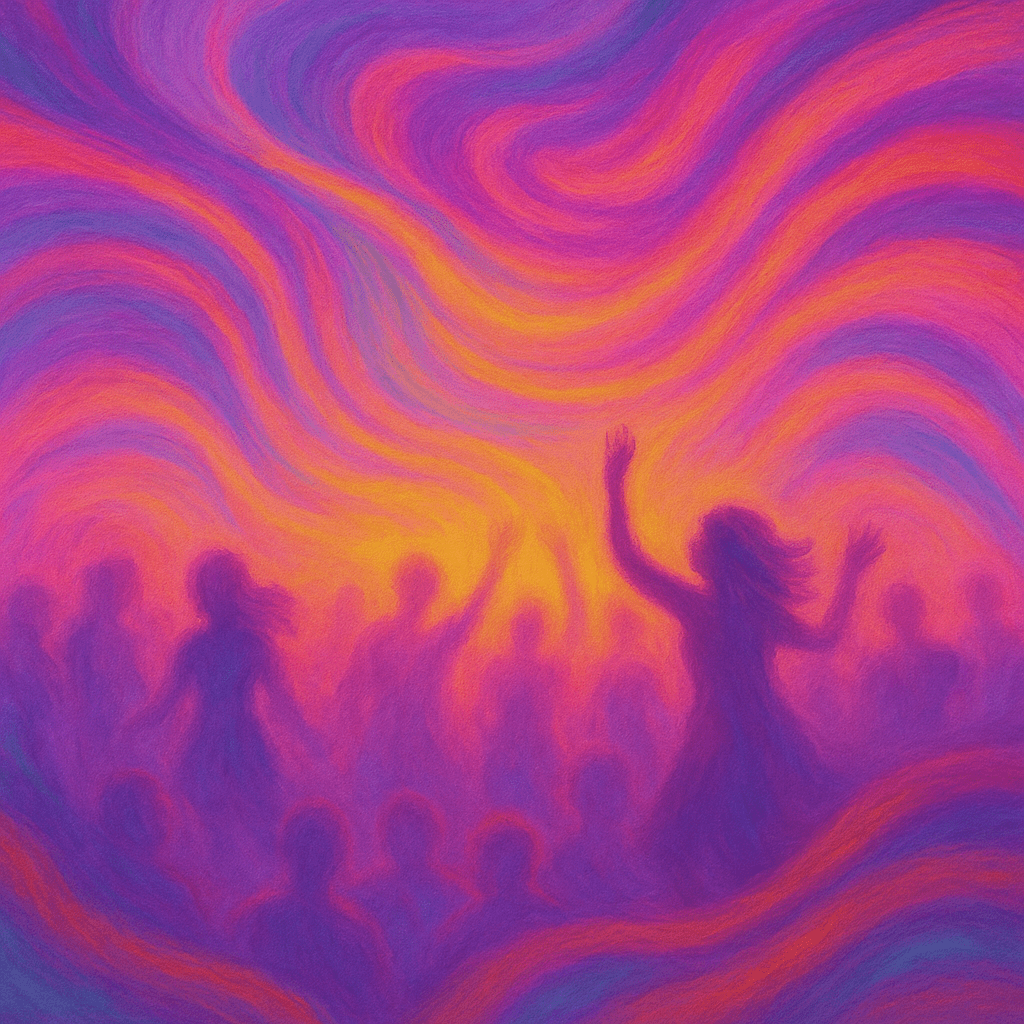
In modern society, the search for transcendence often takes unconventional forms. One of the most compelling examples is the music festival – a contemporary gathering that, while framed as entertainment, often mirrors the structure and impact of ancient ritual and spiritual practice. Beneath the lights and the sound, something deeper is unfolding. Music festivals have emerged as powerful spaces for connection, transformation, and transcendence into expanded consciousness.
Festivals as Catalysts for Altered States of Consciousness
Altered states of consciousness, those that shift us from ordinary waking consciousness, can be accessed in a variety of ways. Traditional methods often rely on sensory immersion, including rhythm, chanting, dance, music, movement, and breathwork. These techniques shift perception, disrupt habitual patterns, interrupt the default mode of being and allow for something more expansive to emerge.
Music festivals, by design, engage many of these same sensory pathways. With music, dancing, movement, and visual stimulation at their core, they naturally lend themselves to nonordinary states of consciousness, creating the conditions for transcendence. In this way, festivals can serve as a sort o catalyst, inviting participants to move beyond the mundane and into an expansive, altered state of being.
The immersive soundscapes and rhythmic patterns of live music, in combination with collective movement, can create trance-like states that loosen the boundaries of identity. Music has always been more than sound. It stirs memory, invokes feeling, and carries us into liminal spaces. When paired with dance and communal energy, it becomes something even more powerful – a pulse that dissolves separation and allows for transcendence.
While some may choose to enhance these experiences with psychedelics or other substances, the festival environment itself, through multisensory immersion, freedom of expression, and emotional resonance, can be enough to induce altered states on its own.
Festivals as Modern-Day Rituals
At their heart, festivals are more than gatherings; they are rituals in disguise. Music festivals mirror many of the key elements of ritual. Anthropologically, rituals are defined by structure, symbolism, and shared intention. They create a container in which transformation can occur, both individually and collectively.
Music festivals follow a similar structured format, with symbolic elements that show up in themes, costumes, visual art, collective anticipation, and even the sacredness of the main stage at sunset. They provide a space where normal social roles are temporarily suspended, allowing participants to engage in more authentic or expressive versions of themselves.
This temporary suspension of ordinary life echoes what anthropologist Victor Turner described as liminality, or a threshold state where individuals are between worlds, open to new insights and identities. In the context of a festival, this liminal space can allow for symbolic ego death, emotional release, and re-entry into daily life with a renewed sense of self or purpose.
It is in these moments, like dancing under the lights, crying during your favorite song, laughing until the sun rises, that something old falls away and something deeper returns. A ritual. A rite of passage.
Collective Effervescence and the Shared Field
One of the most profound forces of the festival experience is the energy of the crowd itself. It is the sense of unity that arises in shared emotional and physical expression. Sociologist Émile Durkheim referred to this phenomenon as collective effervescence, or the experience of shared emotion and synchronized energy that occurs during communal rituals.
In these moments, the dancefloor becomes more than a space or movement; it becomes sacred ground. Strangers become mirrors. Voices sing together. The crowd breathes as one. These shared emotional peaks can lead to a dissolution of personal boundaries, giving rise to a sense of connection with the collective. This connection feels both intimate and infinite – a connection to the group but also a connection to something cosmic.
This state of heightened connection not only fosters belonging, but may also open the door to deeper forms of awareness. These experiences might tap into what Carl Jung called the collective unconscious, or the collection of shared archetypes, emotions, instincts, and symbols common to all of humanity. Within this space, archetypes like ecstasy, rebirth, and unity come alive through the music.
In this sense, festivals become more than cultural gatherings and an escape from reality. Rather, they are reminders of a deeper one, offering a glimpse into the interconnected nature of consciousness itself.
Transformation through Connection
These moments of transcendence and expanded awareness often stay with us. They shift something internal, planting seeds that continue to grow long after the lights go out and the music fades.
When integrated, these moments of expanded awareness and connection often inspire lasting changes in perspective, values, and behavior. Participants may leave with a heightened sense of empathy, a greater appreciation for community, or a deeper understanding of their own identity. These shifts, whether small or profound, reflect the transformative potential of collective, embodied experience. We return home more empathetic, more ourselves.
And so, the festival becomes more than an event. It is a ritual of connection through expanded consciousness. Echoes of ancient practices reimagined in a modern cultural landscape. A remembering of who we are, how we are connected, and what we are here for.
These moments on the dancefloor – where rhythm meets presence and the self dissolves into something greater – often leave us changed. While these moments may be fleeting, they invite us to pause, reflect, and carry their resonance forward.
So this week I invite you to reflect: Have you ever felt yourself dissolve into a moment, whether through music, movement, or shared energy? What did that experience reveal about your connection to self, others, or something greater?
References
Jung, C.G. (1936). The concept of the collective unconscious. C.W. Vol. 9.1. Princeton University Press.
Rimé, B. & Páez, D. (2023). Why we gather: A new look, empirically documented, at Émile Durkheim’s theory of collective assemblies and collective effervescence. Perspectives on Psychological Science, 18(6), 1306-1330.

 Threads of Consciousness